






Inquiry-Based Learning in IB: Fostering Curiosity and Critical Thinking
Mar 11, 2026 Admin
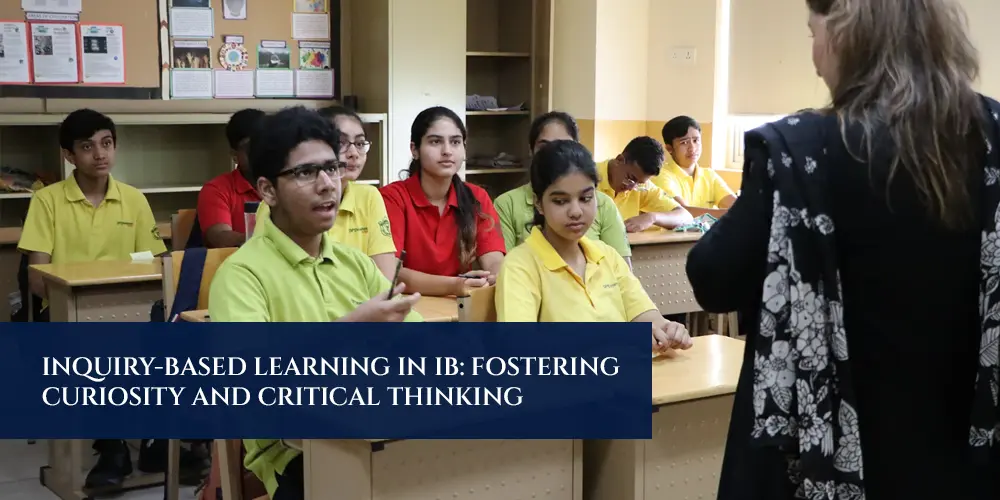
If you’ve ever watched a child explore something entirely new, you’ve probably witnessed the spark of curiosity come alive. They ask, they touch, and they tinker a bit, trying to fathom the world on their own terms. This desire to investigate is exactly what the IB seeks to maintain with inquiry-based instruction.
The IB goes beyond simply teaching a curriculum; it nurtures students’ ability to think independently and stay curious. Rather than treating knowledge as just dates and definitions, the IB believes education should help young people learn to question and understand the world around them from an early age.
This approach to learning has always been meaningful, but in today’s world—where information extends far beyond textbooks—it is more relevant than ever. Here, inquiry is not just a teaching method; it is a mindset. It nurtures lifelong learners who think critically, act independently, and grow with confidence.
Now, let’s delve into how inquiry works, why it is so important and how it creates thinkers.
What Is Inquiry-Based Learning, really?
At its heart, inquiry is simple. It starts with a question. Something as seemingly small to them as “Why does the moon have different shapes?” or as complicated as “Is renewable energy really going to replace fossil fuels?”
In IB rooms, inquiry is the premise for a unit. Rather than being taught information to be stored in memory, students learn by:
- Asking questions
- Exploring ideas
- Observing patterns
- Gathering information
- Reflecting on their findings
- Connecting concepts
- Sharing their learning
This approach ensures that knowledge is not just memorised for exams, but understood deeply. Students develop thinking, logic, curiosity, and a genuine love for learning. And since inquiry encourages self-direction, learners become more confident and comfortable expressing their thoughts.
Why Inquiry Works So Well in the IB Framework
IB education believes that children aren’t empty vessels waiting to be filled; they’re active participants in their own learning journey. Inquiry aligns perfectly with this belief.
Here’s why it fits so naturally into the IB structure:
- Inquiry supports transdisciplinary learning (especially in PYP).
- Students make connections between subjects instead of studying topics in isolation.
- Learning becomes student-led, not teacher-dominated.
- It perfectly complements IB’s focus on holistic education, developing emotional, social and intellectual growth.
Most importantly, inquiry ensures that learning stays authentic. Students don’t just study definitions; they understand how ideas work in the world around them.
Types of Inquiry in the IB Classroom
IB doesn’t use just one form of inquiry; it blends different levels depending on the age group and topic.
1. Structured Inquiry
Teachers provide the question, materials, and process. Students explore with guidance.
2. Guided Inquiry
The teacher introduces the central question, and students choose how they will explore and respond to it.
3. Open Inquiry
Students plan the entire investigation themselves — from framing the question to choosing the method and analysing the results.
Through these stages, they gradually build independence, learning to design their own paths to discover answers.
Real Inquiry vs. “Doing Projects”
A common misunderstanding is that inquiry is just “doing projects.” But true inquiry-based learning goes far deeper.
For example, a student creating a volcano model is doing a project. But a student asking “What makes volcanoes erupt differently around the world?” and then researching real data, comparing lava types, studying tectonic plates, and presenting insights, that’s inquiry.
The difference lies in depth, ownership, and exploration.
The Role of Questions in Inquiry
Inquiry flourishes when students ask the right questions. In IB classrooms, teachers often model questioning techniques, prompting students with:
- Why do you think…?
- What evidence supports this?
- How might this connect to…?
- What could happen if…?
- What do you notice about…?
These questions sharpen critical thinking skills and push students to investigate meaningfully.
How Inquiry Builds Critical Thinking
If there’s one skill every parent wants their child to have, it’s the ability to think clearly. Inquiry strengthens this naturally.
Through inquiry, students learn to:
- Evaluate information instead of accepting it blindly
- Look for patterns and draw conclusions
- Question assumptions
- Recognise multiple perspectives
- Build arguments with evidence
This is where logical thinking is developed, not through memorisation, but through exploration and analysis. No matter the field a student chooses later, science, law, business, arts, or medicine, critical thinking becomes their biggest strength.
Holistic Education Through Inquiry
Inquiry doesn’t just strengthen academic abilities. It supports holistic education, which means the development of the whole child, intellectually, socially, emotionally, and ethically.
Through inquiry, students learn:
- Empathy by understanding diverse viewpoints
- Confidence by presenting ideas
- Collaboration by researching in groups
- Self-management through independent tasks
- Communication through discussions and reflections
All of these are essential life skills that go far beyond the classroom.
Everyday Examples of Inquiry-Based Learning in IB Schools
To understand inquiry in action, here are some simple inquiry-based learning examples:
- Science: Students test different materials to find the best insulator instead of reading about insulation in a textbook.
- Math: They explore patterns in nature to understand symmetry and geometry.
- Language: Students analyse news articles to learn bias, tone, and perspective.
- Social Studies: They study maps and migration stories to understand cultural connections.
- Art: Students experiment with textures to express a theme visually.
Notice how each example pushes students to think, explore, question and reflect, not just follow instructions.
Inquiry and Real-World Problem Solving
One of the most powerful aspects of IB inquiry is its connection to real-world problem-solving. IB learners don’t just study topics; they use their learning to understand global issues.
For example, in MYP or DP, students might explore:
- Climate change solutions
- Renewable energy designs
- Waste management strategies
- Social inequality
- Consumer behaviour patterns
Through research and discussions, they not only learn concepts but also see how knowledge can make a real difference.
This kind of problem-solving mindset is exactly what the future demands.
How Inquiry Builds Student Confidence Over Time
One of the silent ’superpowers’ of inquiry is that it implicitly builds confidence. Regardless of what you’re studying, when students are asked to puzzle through their own questions and predictions, test ideas and then report their findings to others, they become advocates for reasoning. At the outset, some children may be reluctant to voice their thoughts or opinions. Yet, as they accumulate small victories, their sense of belief expands.
They know their ideas have value. What would be errors or mistakes now fall within learning itself; life is what’s learned from and not feared. This confidence extends beyond the classroom into other subjects, social settings, and home life, helping students grow into independent and reflective individuals.
The Teacher’s Role in Inquiry-Based Learning
Contrary to what some may believe, inquiry doesn’t mean teachers step back completely. Their role becomes even more significant. They act as facilitators who:
- Guide students in forming deeper questions
- Help refine ideas
- Provide research tools
- Challenge incorrect assumptions
- Encourage reflection
- Support emotional and academic well-being
Good inquiry teaching requires skill, patience, and understanding. It’s one of the reasons IB-trained teachers are so respected worldwide.
How Inquiry Prepares Students for University and Careers?
Universities today want more than grades. They want students who can:
- Think independently
- Question intelligently
- Write persuasively
- Research thoroughly
- Engage meaningfully in discussions
Inquiry nurtures these abilities from early years to graduation.
In future careers, whether students choose engineering, psychology, business, graphic design, or entrepreneurship, their ability to analyse situations and solve problems will give them a major head start.
Challenges of Inquiry-Based Learning (And Why They’re Worth It)
Like every learning model, inquiry has challenges. Students may find it difficult if they:
- Prefer fixed answers
- Fear of expressing ideas
- Struggle with research
- Need more structure
- Dislike open-ended tasks
But these challenges are exactly what lead to growth. With time and support, students become more confident, independent, and self-aware.
Parents’ Role in Supporting Inquiry at Home
Parents can support inquiry-based learning simply by encouraging curiosity. They don’t need to teach, they just need to:
- Ask open-ended questions
- Listen to children’s ideas
- Encourage exploration
- Value effort over perfection
- Support reading and research
Small habits at home can reinforce big skills in school.
How Inquiry Strengthens Collaboration and Communication
Inquiry isn’t a solo journey. In typical IB classrooms, students collaborate in small groups to explore ideas, compare notes and exchange opinions. This, of course, builds communication and teamwork skills. As actively participating students speak ideas, respectfully challenge one another and construct arguments grounded in evidence, they improve both their capacity to listen deeply and express articulately.
These shared moments also encourage patience, empathy and flexibility, all crucial factors in educating a child as a whole person. When solving a problem or preparing a presentation, students realise that learning becomes deeper and more meaningful when they consider different perspectives.It's a cooperative attitude that gets them ready for actual teamwork in college, the workforce and beyond.
Also read: What Makes the IB Diploma Unique Compared to Other Curricula?
Final Thoughts: Why Inquiry Matters More Today Than Ever
In the age of information, facts are no longer the problem; interpretation is. Children need to be able to question, analyse and understand what they learn.
This is why IB education has inquiry at its core. It educates students to think big, communicate clearly, solve problems empirically and understand the world in an honest and enlightened way.
That’s because critical thinking skills and the invention of curiosity, logic in thinking or abilities to solve real-world problems are a part of inquiry that paves the way for children to become learners who ask more questions than seek answers.
And that’s the type of learning that stays with you through the years.